eSentire is a leader in Controlled Autonomy SecOps, protecting thousands of organizations across 35+ industries around the world. Founded in 2001, the company’s Controlled Autonomy SecOps operating model pairs agentic AI operatives with engineered human-judgment controls, delivering expert-depth security outcomes at machine speed without ceding accountability to opaque automation.
We provide sophisticated cybersecurity solutions for Managed Security Service Providers (MSSPs), Managed Service Providers (MSPs), and Value-Added Resellers (VARs). Find out why you should partner with eSentire, the Authority in Managed Detection and Response, today.
Surge in Microsoft Teams-Based Phishing and IT Support Impersonation
September 25, 2026
7 MINS READ
Share this article
THE THREAT
eSentire's Threat Response Unit (TRU) has continued to observe a sustained increase in attacks involving Microsoft Teams-based phishing and IT Support impersonation. These types of attacks involve threat actors contacting users over Microsoft Teams, posing as IT Support or a colleague, and attempting to trick users into granting remote access to their device through a Remote Monitoring and Management (RMM) tool. Observed cases have resulted in the deployment of Remote Access Trojans (RATs), information stealers, and backdoors, which can ultimately lead to data theft or ransomware.
To protect against this threat, organizations should restrict communication with external domains within Microsoft Teams, using allowlists for approved external domains as needed. Organizations should also educate users on this attack method and create internal processes for users to validate support requests through secondary channels.
What We're Doing About It
eSentire MDR for Log has detections in place to identify email bombing activity and Microsoft Teams messages originating from external accounts from high-risk sources
eSentire MDR for Endpoint has detections to identify RMM abuse, domain reconnaissance, application control bypass attempts, and malware and ransomware deployment
IP addresses associated with real-world attacks are blocked via the eSentire Global Block List available to eSentire MDR for Network customers
Indicators of Compromise (IoCs) have been added to the Threat Intelligence Feed and are available for Threat Feed subscribers
The eSentire Threat Intelligence team is actively tracking this topic for additional details and detection opportunities
What You Should Do About It
Microsoft Teams messages and calls from external organizations should be restricted unless necessary
If required, restrictions should be placed to only allow messages and calls from trusted business partners
Organizations should enable anti-phishing indicators within Microsoft Teams which can provide clear warnings about potentially suspicious or external messages
User Awareness Training should be conducted to educate users on these attacks and what to look out for
Employees should also be educated on standard internal processes for escalating issues
Create processes for users to verify any unexpected IT request through a secondary, trusted channel, such as calling the official helpdesk number, emailing them directly, or using an internal ticketing system
Training should incorporate anti-phishing indicators from Teams, educating users on how to identify and respond to these indicators
Organizations should restrict sign-in access to compliant or hybrid Azure AD-joined devices
Continuous Access Evaluation (CAE) should also be enabled to ensure that access tokens are revoked promptly in response to relevant risk signals, rather than remaining valid until their scheduled expiration
Remote Access tools (e.g. Quick Assist, AnyDesk, ConnectWise) should be restricted via policy, unless required for normal operations
If required, a single remote access tool should be standardized and all other RMM tools should be blocked with application control
File Transfer Utilities (e.g. WinSCP, RClone, FileZilla, MegaSync) should be restricted via policy, unless required for normal operations
Additional Information
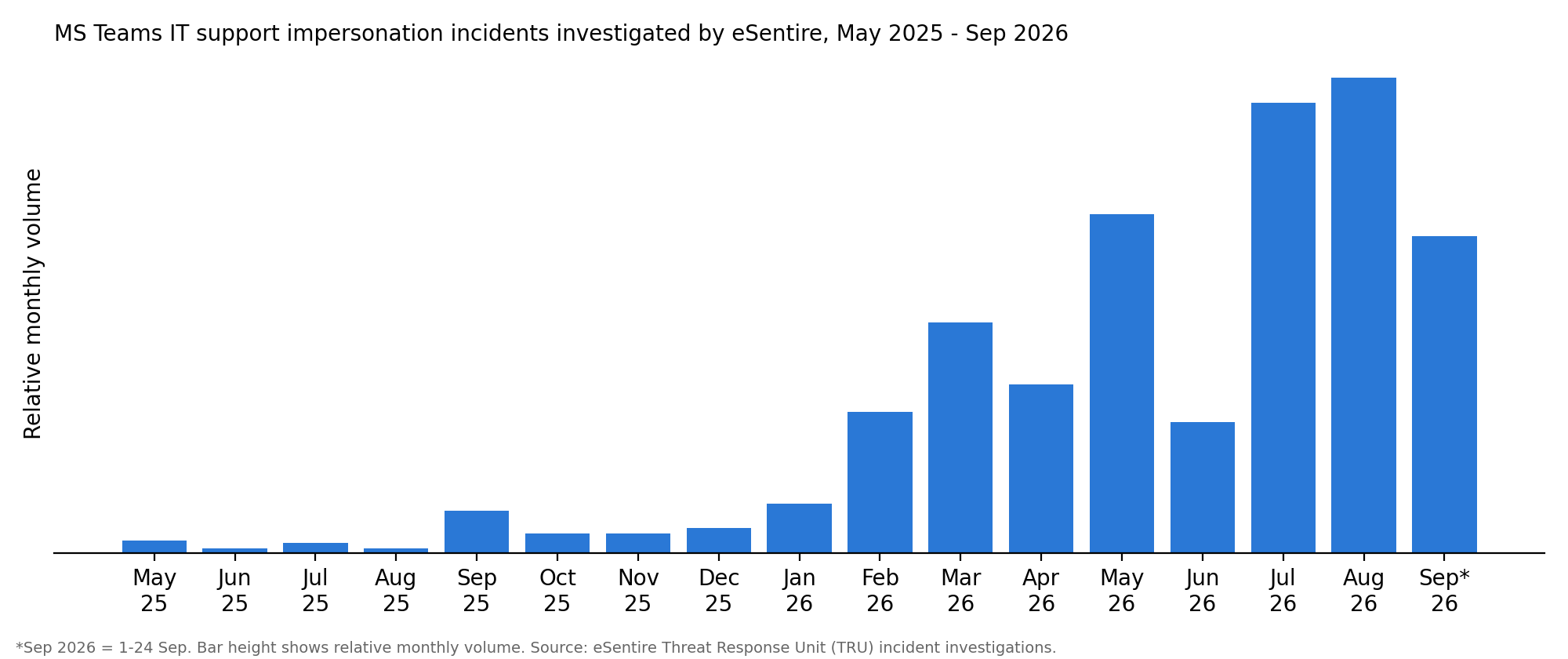
Microsoft Teams IT support impersonation has become one of the most frequently observed attack types investigated by eSentire. Throughout most of 2025, only a small number of cases were observed each month. Activity increased in late 2025, accelerated in early 2026, and has remained consistently elevated since July 2026, with multiple new attempts observed daily. Current volume is more than twenty times higher than during the same period in 2025 and more than double the rate observed in the first half of 2026.
Figure 1 – Monthly Microsoft Teams IT support impersonation incidents investigated by eSentire, May 2025 - September 2026
Manufacturing and legal services were the most frequently targeted industries over the last 90 days, accounting for 20% and 16% of incidents respectively, or more than a third of all cases. Law firms were notable for repeated targeting, with the same firms contacted on multiple occasions, and several attorneys or staff members often targeted in quick succession. Retail (9%), business services (8%), software (8%), and finance (7%) organizations were also frequently targeted, followed by insurance and construction.
Observed activity indicates coordinated campaigns rather than isolated attempts. Approximately one in seven cases involved multiple employees at the same organization within a short timeframe, and approximately 13% of observed attacker domains, email addresses, and IP addresses were used against more than one eSentire customer, including individual sending IP addresses observed across multiple organizations. In addition to IT support personas, threat actors are also impersonating colleagues or using generic display names to initiate contact.
Both IT support impersonation and generic display name approaches are closely associated with email bombing. In a number of cases, the targeted user's inbox was first flooded with spam or subscription emails, providing a pretext for the threat actor to make contact and offer assistance.
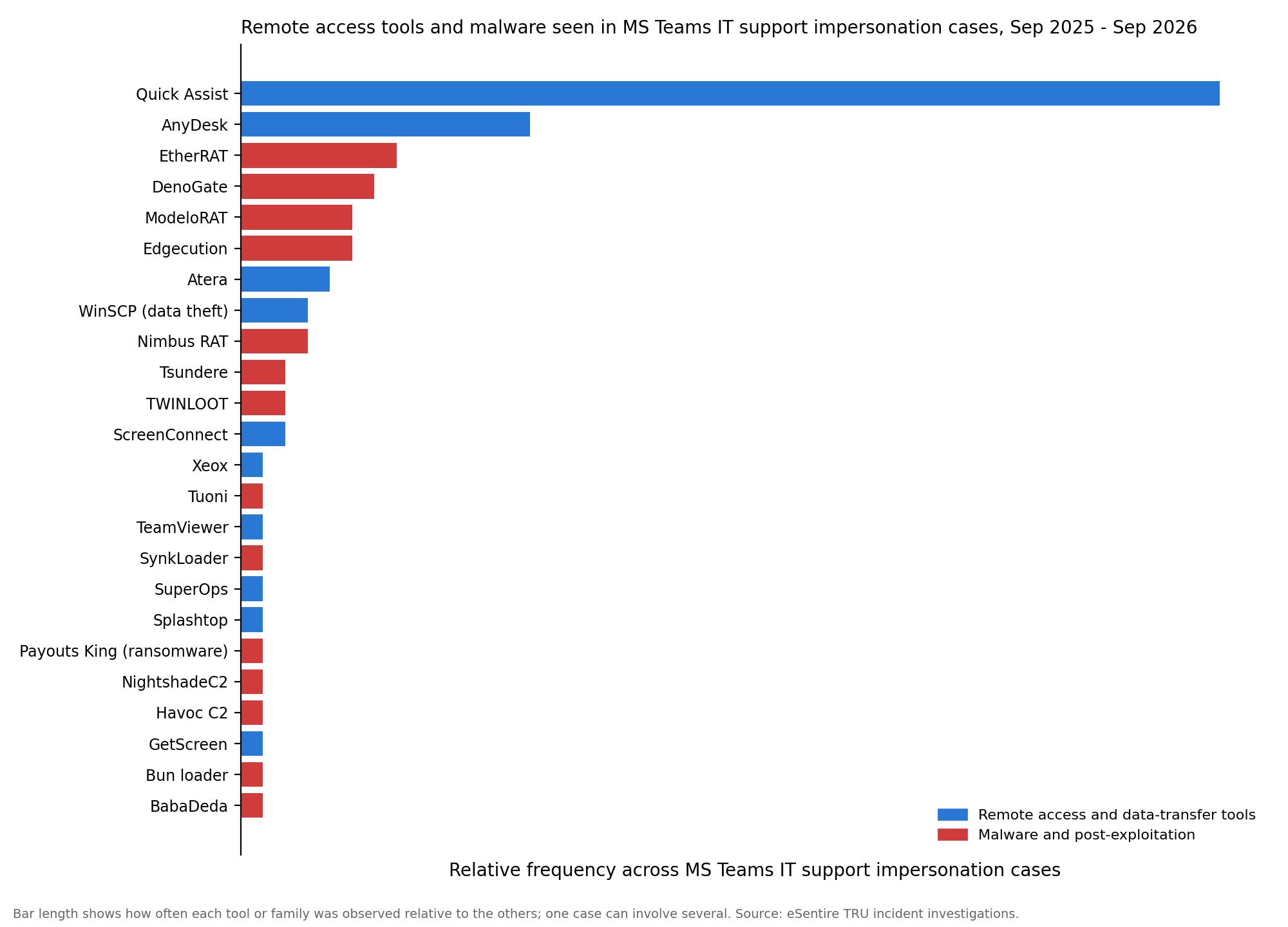
Following initial contact, threat actors often use Quick Assist to gain remote access, observed in nearly 60% of cases where a remote access tool or malware payload was identified, followed by AnyDesk, Atera, ScreenConnect, TeamViewer, Splashtop, SuperOps, Xeox, and GetScreen. In two cases analyzed, malware was deployed within one hour of the Quick Assist session being established. Secondary payloads observed include:
EtherRAT: Node.js backdoor that retrieves Command-and-Control (C2) addresses from Ethereum smart contracts; delivered as a fake MSI "hotfix" in observed cases
DenoGate: Deno-based JavaScript backdoor capable of proxying traffic through the victim's device
Edgecution: malicious Microsoft Edge extension that escapes the browser sandbox to install a Python backdoor
Nimbus RAT: Java-based RAT that uses Google Drive and Google Sheets for C2 and displays a fake Windows security prompt to capture credentials
TWINLOOT: Python implant that routes C2 through SharePoint and Microsoft Teams relay servers using a hidden Microsoft Edge browser
SynkLoader: loader that displays a fake Windows lock screen to capture credentials
WinSCP: file transfer utility used for data exfiltration
Many of these payloads execute through legitimate runtimes (Node.js, Deno, Python, Java) placed in the user's profile, which can reduce detection by signature-based controls.
Several observed payloads have documented links to ransomware operations. Edgecution, observed in multiple cases between late June and early August 2026, is used by UNC6692, an Initial Access Broker (IAB) that follows the same email bombing, Microsoft Teams, and Quick Assist playbook and sells access to the Payouts King ransomware operation. One July 2026 case was directly linked to Payouts King. Nimbus RAT has been associated with BlackSuit ransomware affiliates.
Figure 2 – Remote access tools and malware seen in MS Teams IT support impersonation cases investigated by eSentire, September 2025 - September 2026
Threat actors rely on disposable infrastructure, including help desk-themed domains, newly created Microsoft 365 tenants, and VPN and hosting IP addresses that are rotated once blocked. The indicators below are a sample from recent cases; eSentire maintains a larger, regularly updated blocklist.
eSentire assesses with moderate to high confidence that Microsoft Teams-based impersonation will remain one of the most common initial access techniques through the end of 2026. The technique requires minimal investment, does not require malware for initial contact, and exploits external collaboration settings that many organizations leave enabled. As organizations restrict external access and block newly created tenants, threat actors are expected to shift toward compromised legitimate tenants and consumer accounts, extend the same approach to phone calls, SMS, and other collaboration platforms, and replace Quick Assist with less common remote access tools or built-in screen sharing features. Professional services organizations that collaborate extensively with external parties, including law firms, are likely to remain at priority targets.